
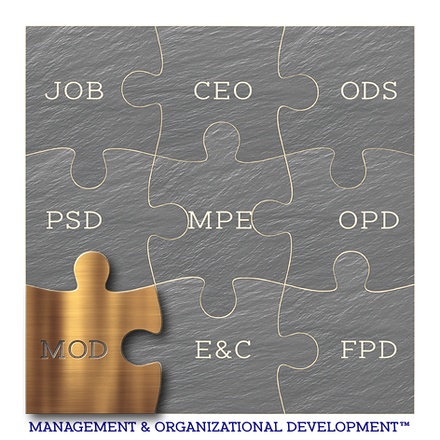
Management & Organization
Development - MOD™
Management & Organization Development (MOD™) is a comprehensive leadership and organizational planning framework designed to help students develop a thorough understanding of the individuals who contribute to the success of an organization, the roles they perform, and the value their experience and expertise bring to the enterprise. The program emphasizes the importance of effective leadership, strategic management, organizational structure, professional support systems, and succession planning. Through a detailed examination of management resources and organizational relationships, students gain the knowledge necessary to build a strong leadership foundation capable of supporting organizational growth, sustainability, and long-term success.
The process begins with the Professional Biographies Development (PBIOD™)segment, which focuses on documenting the qualifications, experience, and accomplishments of the organization's owners, founders, executive leaders, and key personnel. Students learn how to develop professional biographies that highlight educational backgrounds, professional certifications, industry experience, leadership achievements, and specialized expertise. These biographies help demonstrate the credibility and competence of the management team to investors, lenders, board members, strategic partners, and other stakeholders. In addition, students review and evaluate the resumes of key employees and managers to identify the skills, qualifications, and experience that contribute to organizational effectiveness and strategic objectives.
The Management Experience Assessment (MGEA™) component evaluates whether the existing leadership team possesses the knowledge, skills, and experience necessary to successfully manage and grow the organization. Students examine prior business experience, industry-specific expertise, leadership capabilities, decision-making competencies, and operational knowledge. This analysis helps identify strengths within the management team while also highlighting potential areas that may require additional training, recruitment, or outside expertise.
The Gaps Analysis and Development (GA&D™) segment assists students in identifying deficiencies within the organization's management structure, technical expertise, operational capabilities, or leadership resources. This assessment examines areas where experience, knowledge, or specialized skills may be lacking. Once identified, students develop strategic plans to address these gaps through hiring initiatives, professional development programs, mentorship arrangements, consulting relationships, outsourcing opportunities, or strategic partnerships. By proactively addressing managerial and operational deficiencies, organizations can minimize risk and improve their ability to achieve strategic goals.
An important feature of MOD™ is the development of an Advisory Support Team (AST™). This segment guides students through the process of identifying and recruiting experienced professionals, business leaders, subject matter experts, mentors, and trusted advisors who can provide valuable guidance and support. These individuals offer objective perspectives, industry insights, practical experience, and strategic advice that can help organizational leaders avoid common mistakes and make more informed decisions. The Advisory Support Team serves as a valuable resource for leadership development, operational problem-solving, and long-term strategic planning.
The Professional Advisors Development (PAD™) component focuses on establishing relationships with qualified professionals who can provide specialized expertise critical to organizational success. Students learn the importance of building partnerships with attorneys, accountants, tax professionals, financial advisors, insurance consultants, human resource specialists, compliance experts, and other professional service providers. These advisors help ensure that the organization remains compliant with legal and regulatory requirements, maintains accurate financial records, manages risk effectively, and makes sound business decisions. Additionally, students explore the benefits of forming a Board of Directors or an Advisory Board, both of which can provide governance oversight, strategic direction, accountability, and access to valuable professional networks.
The Leadership and Governance Structure Assessment (L&GSA™) helps students understand how authority, responsibility, and decision-making functions are distributed throughout an organization. This process examines leadership roles, reporting relationships, management responsibilities, and governance procedures. Students learn how clearly defined leadership structures improve communication, increase accountability, streamline operational processes, and support effective decision-making.
A critical aspect of MOD™ is the Organizational Hierarchy Development (OHD™) segment, which focuses on creating visual and functional representations of the organization's structure. Students develop organizational charts, reporting frameworks, departmental structures, workflow systems, and chain-of-command models that clearly define roles and responsibilities throughout the organization. These tools help management and staff understand how departments interact, where responsibilities reside, and how decisions are communicated and implemented. A well-designed organizational hierarchy promotes efficiency, reduces confusion, and supports organizational growth.
The MOD™ also emphasizes Succession and Continuity Planning (S&CP™), ensuring that organizations are prepared for leadership transitions and future expansion. Students learn how to identify future leaders, develop leadership pipelines, create succession strategies, and preserve institutional knowledge. This planning helps organizations maintain operational stability and leadership continuity during periods of change.
Additionally, MOD™ encourages the development of a strong organizational culture by aligning leadership practices, organizational values, communication systems, and employee engagement initiatives. Students learn how effective leadership influences morale, productivity, accountability, innovation, and overall organizational performance.
Through these integrated components, Management & Organization Development (MOD™) provides students with a comprehensive framework for evaluating leadership capabilities, building effective management teams, developing professional support networks, establishing governance systems, and designing organizational structures that promote efficiency and accountability. By focusing on people, leadership, organizational design, and strategic support systems, MOD™ equips future organizational leaders with the knowledge and tools necessary to create well-managed, sustainable, and growth-oriented organizations capable of thriving in competitive and evolving environments.